


If you’ve ever stood in front of a supply catalog trying to decide between a procedural mask, an N95 respirator, and a surgical N95, you’re not alone. The three look similar, their names get used interchangeably, and the differences aren’t always obvious, but they matter. The right choice depends on what you’re protecting against, who’s wearing it, and the setting it’s used in.
At RL Specialty, we’ve supplied medical face masks and respirators to hospitals, nursing homes, home health agencies, and family caregivers for more than 60 years. This guide breaks down the three main categories, including medical face masks, N95 respirators, and NIOSH-approved surgical N95 respirators, so you can order the right protection with confidence.
Medical Face Masks: Everyday Barrier Protection
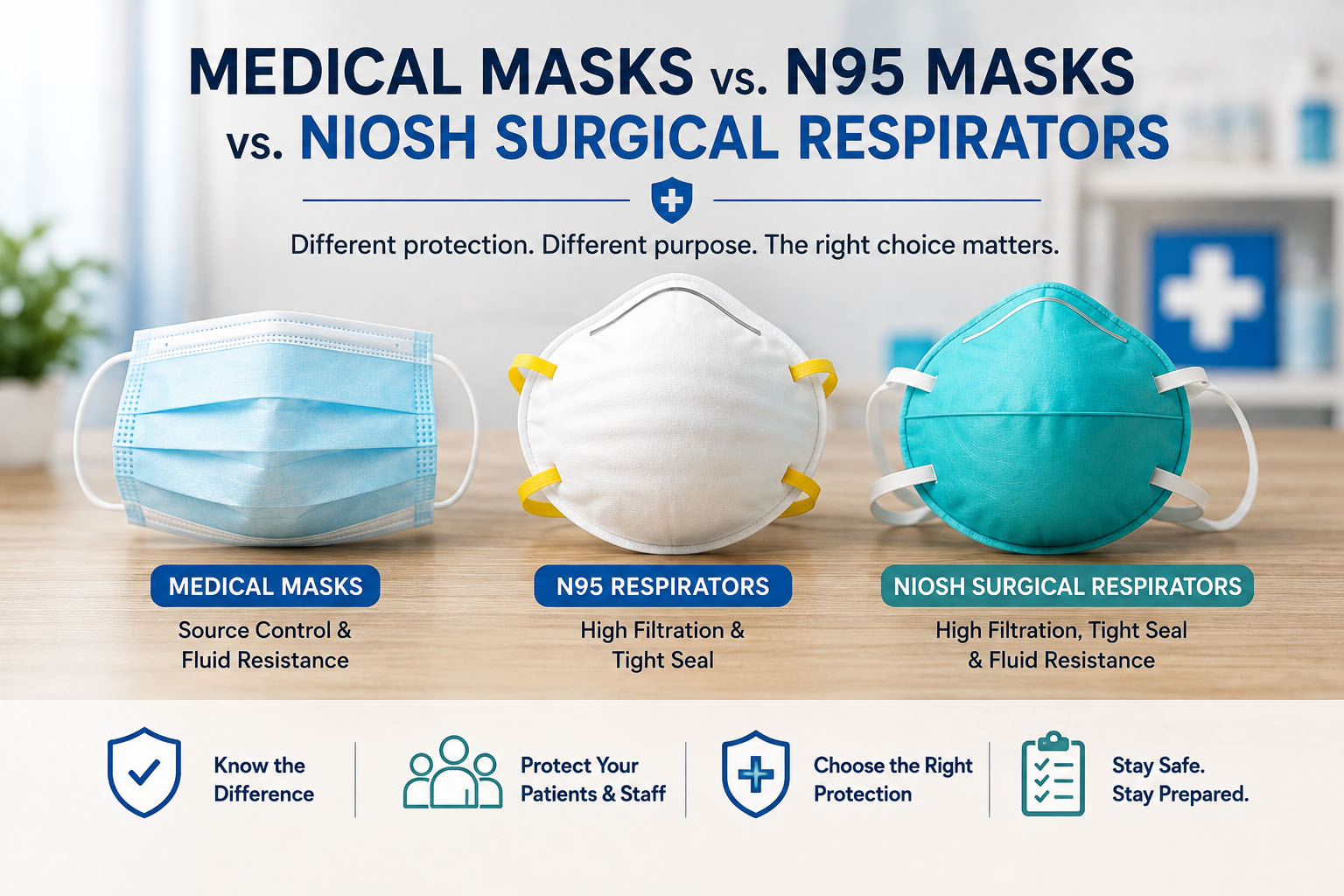
Medical face masks, also called surgical masks, procedural masks, or clinical face masks, are the familiar pleated masks you see throughout clinics and care settings. They are regulated by the U.S. Food and Drug Administration (FDA) and are typically rated to the ASTM F2100 standard, which defines three levels of barrier performance, from Level 1 for lower fluid exposure up to Level 3 for heavier exposure.
In practical terms, those ASTM levels tell you how much fluid a mask can handle. A Level 1 mask is well suited to routine exams, general patient care, and everyday use where fluid exposure is low. Level 2 and Level 3 masks add higher fluid resistance and are chosen for procedures that may generate moderate to heavy splashes or sprays. All three share the same basic job: a comfortable, breathable barrier that helps keep droplets from passing in either direction.
What medical face masks do
- Create a physical barrier over the nose and mouth.
- Help block large respiratory droplets, splashes, and sprays.
- Protect others from the wearer’s own respiratory emissions (source control).
- Attach with ear loops (procedure masks) or ties (traditional surgical masks).
What they don’t do: Medical face masks fit loosely against the face, so air and very small airborne particles can leak around the edges. They are not fit-tested and are not designed to seal. That makes them ideal for routine care, source control, and splash protection, but not for filtering fine aerosols.
Best for: General clinical use, patient rounds, exam rooms, reception and front-desk staff, and everyday protection across assisted living and home care. RL Specialty’s procedural face masks meet the ASTM F2100 Level 1 standard and ship in convenient bulk cases.
N95 Respirators: Higher Filtration, Tighter Seal
An N95 mask is a respirator, not a simple mask, and that distinction is the heart of the difference. N95 respirators are tested and approved by NIOSH (the National Institute for Occupational Safety and Health) under the federal standard 42 CFR Part 84. The “N95” designation means the respirator filters at least 95% of airborne particles, while the “N” indicates it is not resistant to oil-based particles.
What sets N95 respirators apart
- Filter at least 95% of very small (0.3-micron) non-oily airborne particles.
- Form a tight seal around the nose and mouth, held in place by elastic straps.
- Require fit testing to confirm a proper seal for each individual wearer.
- Reduce the wearer’s exposure to airborne particles, including fine aerosols.
It also helps to understand how the rating system works, because N95 is only one option in a larger family. NIOSH uses a letter to describe oil resistance, N for not oil-resistant, R for somewhat oil-resistant, and P for oil-proof, followed by a number for filtration efficiency: 95, 99, or 100 (which filters 99.97%). An N95 is the most common choice in healthcare because most airborne hazards in those settings are non-oily particles. The reason NIOSH tests filters against 0.3-micron particles is that this size is the hardest to capture; a filter that stops 95% of those “most-penetrating” particles will perform even better against larger and smaller ones.
Because a standard N95 respirator seals to the face, it protects the wearer far more effectively against airborne particles than a loose-fitting medical mask. The seal is what makes it work; facial hair, the wrong size, or an improper fit can all compromise protection, which is why fit testing and a user seal check are part of proper respirator use.
Best for: Settings where staff may be exposed to airborne particles and aerosols, such as airborne-precaution rooms and higher-risk care tasks. Explore RL Specialty’s N95 particulate respirators for dependable, NIOSH-approved filtration in bulk quantities.
NIOSH Surgical N95 Respirators: Respiratory + Fluid Protection
A surgical N95 respirator is a special subset of N95 that carries two approvals at once: it is NIOSH-approved as an N95 respirator and FDA-cleared as a surgical mask. That dual clearance means it delivers the tight-sealing, 95%-plus particle filtration of an N95 together with the fluid resistance of a surgical mask.
The added feature is fluid resistance, the ability to resist penetration by high-pressure splashes of blood or other fluids, verified using the ASTM F1862 synthetic-blood test. Surgical N95s are regulated as Class II medical devices under both 21 CFR 878.4040 (FDA) and 42 CFR Part 84 (NIOSH). You may also see them called medical respirators, healthcare respirators, or simply surgical N95s.
Like other respirators and medical masks, surgical N95s are single-use items. They should be discarded when they become damaged, soiled, or hard to breathe through, and ideally after each patient encounter. Because they still require a tight seal, the same fit-testing and seal-check rules that apply to standard N95s apply here too.
Best for: Procedures and environments where a caregiver faces both airborne particles and the risk of splashes or sprays such as operating rooms, sterile procedures, and other high-exposure clinical tasks. RL Specialty’s NIOSH surgical N95 respirator masks give facilities respiratory and fluid protection in a single, dual-cleared product.
Quick Comparison: Masks and Respirators at a Glance
Use this side-by-side view to match the right protection to your needs:
| Feature | Medical Face Mask | N95 Respirator | Surgical N95 Respirator |
| Main purpose | Barrier & source control | Airborne particle filtration | Airborne + fluid protection |
| Regulated by | FDA | NIOSH | NIOSH + FDA |
| Filtration | Blocks large droplets | ≥ 95% of 0.3-micron particles | ≥ 95% of 0.3-micron particles |
| Fit | Loose-fitting | Tight, sealed | Tight, sealed |
| Fit testing | Not required | Required | Required |
| Fluid resistance | Varies by ASTM level | Not required | Yes |
| Typical use | Routine care, everyday wear | Airborne precautions | Surgery, high-exposure care |
How to Choose the Right Mask for Your Setting
For Facilities and Procurement Teams
Match the mask to the task and its risk level. Stock medical face masks for routine, high-volume everyday use; N95 respirators for airborne-precaution scenarios; and surgical N95 respirators wherever both airborne particles and splash risks are present. Many hospitals, surgical centers, and long-term care facilities keep all three on hand and follow their own infection-control protocols along with OSHA’s Respiratory Protection Standard (29 CFR 1910.134) for respirator use and fit testing.
Buying in bulk keeps costs predictable and shelves stocked, but it helps to plan your mix ahead of time. Because medical face masks tend to move in the highest volume, they are often ordered by the case, while respirators are typically stocked in the quantities your protocols require for higher-risk tasks. Keeping the right ratio on hand avoids both shortages and overstock, and having a dependable supplier makes reordering simple.
For Home Caregivers and Families
Most day-to-day home care needs are met by quality medical face masks for source control and everyday protection. If a physician or care plan calls for respirator-level protection, an N95 is the step up, just remember that a proper seal is what gives it its protective value. When both a snug seal and splash protection are needed, a surgical N95 covers both.
A simple rule of thumb: Splashes and droplets call for a medical face mask, airborne particles call for an N95 respirator, and both risks together call for a surgical N95.
Medical Masks vs. N95 Masks vs. NIOSH Surgical Respirators FAQs
Is an N95 mask the same as a surgical mask?
No. A surgical (medical) mask is a loose-fitting barrier regulated by the FDA, while an N95 is a tight-sealing respirator approved by NIOSH that filters at least 95% of airborne particles.
What makes a surgical N95 different from a regular N95?
Fluid resistance and FDA clearance. A surgical N95 is both NIOSH-approved and FDA-cleared as a surgical mask, so it adds splash protection on top of N95-level filtration.
Do medical face masks need fit testing?
No. Only respirators such as standard N95s and surgical N95s require fit testing to confirm a proper seal for each wearer.
Can I buy N95 masks in bulk?
Yes. RL Specialty offers bulk and wholesale N95 masks, surgical N95 respirators, and medical face masks for both facilities and individual caregivers.
Stock Up on Masks and Respirators with RL Specialty
Whether you’re outfitting a hospital, nursing home, home health operation, or a home care setup for a loved one, RL Specialty makes it easy to get the right protection at the right price. For more than 60 years, we’ve supplied dependable, professional-grade PPE with competitive bulk pricing and fast, reliable shipping.
→ Shop NIOSH Surgical N95 Respirators: https://rlspecialtyhealth.com/ppe/medical-masks/n95-surgical-mask/
→ Shop N95 Particulate Respirators: https://rlspecialtyhealth.com/ppe/medical-masks/n95-respirator/
Still not sure which mask is right for your facility or your care routine? Contact our team to discuss bulk and wholesale orders. We’ll help you get the right products, in the right quantity, delivered reliably.